George
The One and Only IvanGeorge is Julia’s father and the mall’s night cleaner, a man whose influence is usually expressed through routine rather than authority. He mops and sweeps while the mall empties, and his everyday work places him close to the animals and to the campaign that will challenge their confinement. Though he initially refuses to help Julia put Ivan’s picture on a billboard, the thought that Ruby could meet Stella’s fate changes his response. His practical assistance becomes a crucial human link between Julia’s appeal and the public effort to find the animals a new home.
Identity and Background
While George cleans the mall each night, Julia chooses to sit beside Ivan, although she could spend that time elsewhere in the building. Their shared evenings establish George’s work as both a livelihood and the setting for his daughter’s friendships and drawing. He is not presented as an animal trainer or decision-maker: his tools are a mop, a broom, and, when Julia’s plan demands it, access to a ladder and glue.
George’s wife, Sara, used to help clean the mall as well. When illness left her pale and stooped, she stopped coming. Julia offers to help her father every night, but George firmly directs her back to her homework, explaining that the floors will only get dirty again. The exchange reveals his protective care in an ordinary form: he does not accept his child’s offer of labor, even as the family’s circumstances have changed. Sara’s illness is given only through these details, while George’s insistence on Julia’s schooling is explicit.
Work and Family Life at the Mall
George’s working relationship with Mack is framed through the familiar repetition of late-night chores and small talk. One night, after Mack has stayed late in his office, George joins him with a broom in hand. Mack falls back on routine remarks about a game, slow business, and emptying the trash. George’s presence in this exchange locates him within the mall’s daily operation: he works under Mack and shares the quiet hours after the shows, but the conversation offers no sign that he controls the business or its decisions.
His work also puts him nearby when the animals’ immediate condition becomes hard to ignore. When Julia sees Stella lying in dirty hay and breathing raggedly, she calls for her father. George sets aside his mop and comes to her. Julia asks whether Stella is all right and urges that Mack be called because something seems seriously wrong. The scene does not record George’s diagnosis or what he says in response; it shows instead that he attends to Julia’s alarm, leaving his task to look at the crisis she has noticed.
The Billboard Decision
George’s most consequential choice comes when Julia begs him to help with the billboard campaign. He refuses directly, rejecting the idea of putting the picture there. Julia nevertheless lays out a practical plan: she will get the ladder, and he can get the glue. His resistance marks a real obstacle, not a lack of affection; the evidence establishes his refusal but does not state a reason for it.
The turning point is Julia’s question about whether Ruby might end up like Stella. George looks at Ivan, Ruby, and Julia, then drops the claw-stick. He tells Julia where the ladder is stored. The shift is conveyed through a small physical action and a changed instruction: the man who had said no now makes the equipment available. He does not give a speech about the animals or explain his feelings. The comparison with Stella’s suffering is enough to change what he is willing to do, and his practical cooperation enables Julia’s appeal to move forward.
Afterward, George returns to his work. His mop crosses the empty food court like a giant brush, making an unseen picture. The image quietly joins his labor to the book’s recurring attention to art: Ivan and Julia draw to communicate, while George’s ordinary cleaning takes on the shape of an artwork that no one will see. The contrast is not a claim that George becomes an artist; it makes his uncelebrated work visible beside the picture campaign he has helped permit.
Inspection, Dismissal, and Departure
The campaign unfolds alongside an inspection of the mall’s animals and facilities. A man with a clipboard checks Ivan’s floor, Ruby’s hay, and the water bowls, marking each item on his paper. A week later he returns with a woman in a white coat; after she watches Ivan and Ruby, the two visitors speak with Mack, and the man gives Mack a sheet of paper. George is not identified as a participant in these visits, but their sequence provides the institutional context for the changes taking place at the mall.
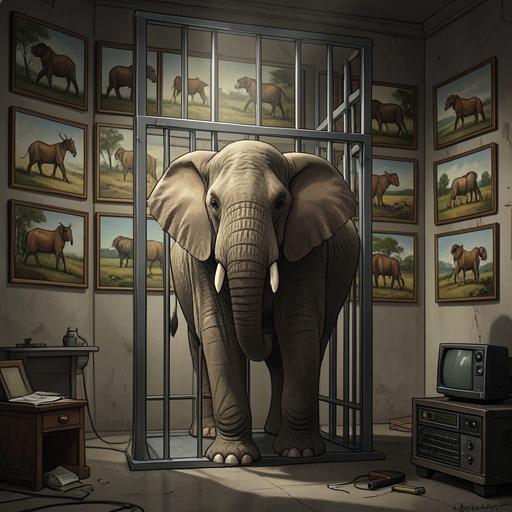
When the woman later returns with other people and a large box sized for Ruby, Ivan understands that she has come to take the elephant away. Another, metal box is then placed in the ring, this one sized for Ivan. Against this approaching departure, George’s own position at the mall also changes. On Julia’s last night there, he does not take out his mop or broom; he gathers his tools and belongings. Julia tells Ivan that Mack fired her father. She adds that the woman from the zoo said there might eventually be an opening cleaning cages. The possibility is prospective, not a confirmed new job, and George’s departure from the mall is immediate.
Relationships and Narrative Significance
George’s relationship with Julia is the clearest measure of his character. He sets limits when she offers to work, resists her plan when she asks for his help, and ultimately changes course when she makes Ruby’s vulnerability impossible to set aside. Later, when Julia presses her palm to Ivan’s glass and tells him this is her last night, George is with her as they leave. At a later visit, he pats her arm and says it is time to go; Julia bids Ivan farewell and thanks her father, though the reason for her thanks is left unstated in the scene.
George’s role is modest but consequential. He cannot decide the mall’s future, prevent Mack from firing him, or guarantee that the zoo will hire him. He can, however, choose whether to help his daughter act. His initial refusal and eventual cooperation keep that choice visible: the campaign is not effortless, and compassion does not erase the practical risks and losses surrounding the people who work at the mall. Through George, the story connects animal welfare to ordinary human labor, family responsibility, and a concrete act of assistance.